Deciphering Bronze Inscriptions: From Casting Pit to Reading Room
Bronze inscriptions are the longest and most literary texts of the early Chinese record. Casting technique, layout and formulaic language all shape how we read them.
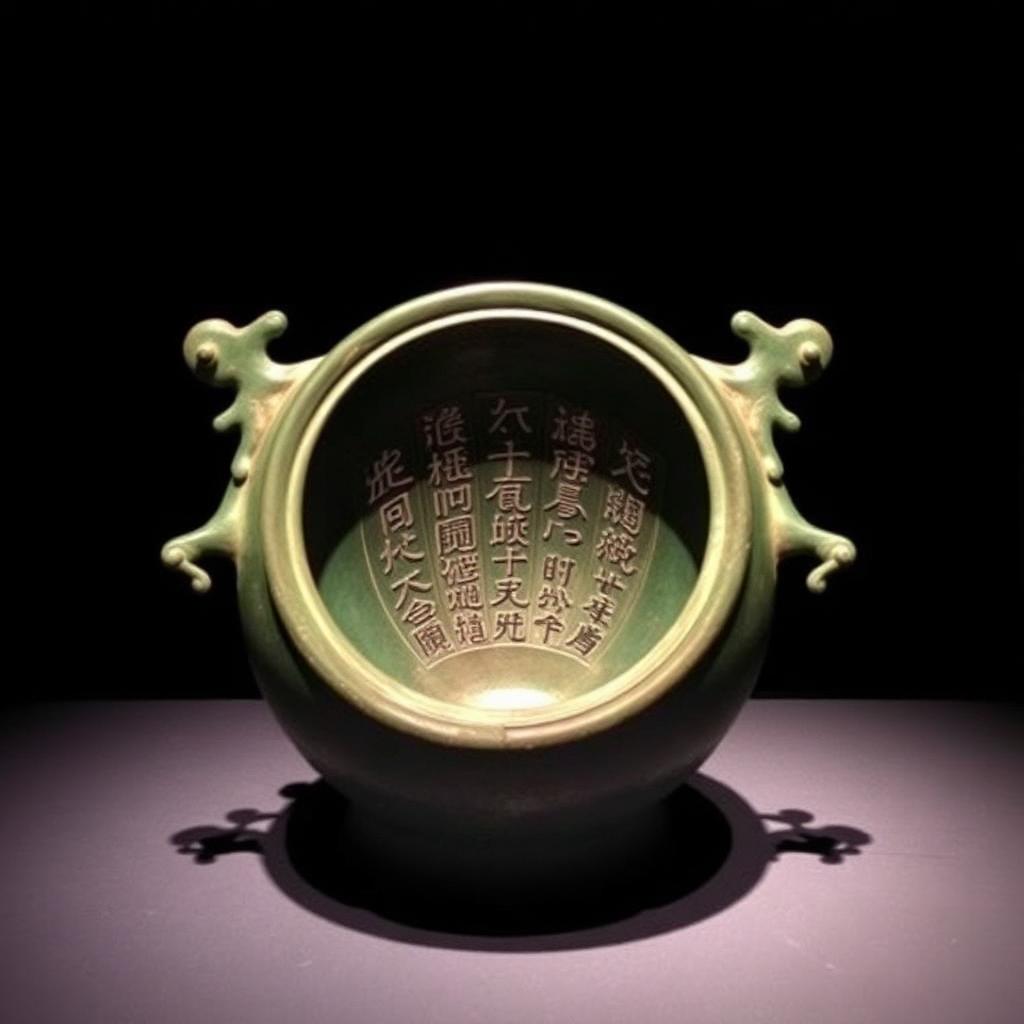
If jiaguwen is the telegram of the early Chinese record, jinwen — the inscriptions cast onto Shang and Zhou bronze ritual vessels — is the letterpress book. Individual bronze inscriptions can run to more than five hundred characters, deploy full literary syntax, and record legal contracts, land grants, military campaigns and ancestral genealogies with a precision that oracle bones never attempt. For the working paleographer they are also, arguably, the single most rewarding corpus to learn.
The first thing to understand about a bronze inscription is that it is not written. It is cast. The scribe brushed the text onto a clay model; the model was pressed into an outer mould; a negative core was assembled around it; molten bronze was poured in. Every graph you read on the surface of a ding or gui was originally raised or incised in reverse on a lump of clay. That process has consequences. Strokes are thicker and more even than brushwork of the same period would be. Long horizontals sometimes sag under the weight of their own inversion. And the boundary between adjacent graphs is often marked not by a space but by a slight ridge left over from the joint between two mould sections.
Second, position matters. On a food vessel such as a gui or a li, the inscription is almost always cast on the interior wall or the bottom of the belly. On a wine vessel such as a zun or a you, it may be on the interior of the neck, the underside of the lid or, in later Western Zhou pieces, on the exterior. Reading order tracks the vessel's function: the inscription is meant to be seen by the ancestral spirit who receives the offering, not by the diner. That is why so many jinwen texts read as if the vessel itself is speaking — "X made this precious ding" — and why the closing formula is almost always a dedication to a named ancestor, followed by the phrase 子子孫孫永寶用, "may sons and grandsons treasure and use it forever."
Once you have located the text and its reading order, the third question is date. Bronze inscriptions divide broadly into four stages. Shang bronzes carry short, often single-graph clan emblems. Early Western Zhou pieces are longer, calligraphically vigorous and full of royal grant language: appointments, rewards of cowries, gifts of chariots. Middle Western Zhou inscriptions become more formulaic; the graph shapes stabilise; the ductus grows rounded. Late Western Zhou and early Springs-and-Autumns pieces begin to show regional variation, particularly in the states of Chu, Qin and Qi, and the graphs elongate and become more decorative.
The formulaic character of bronze inscriptions is a friend to the beginner. A typical mid-Western Zhou award inscription follows a predictable script: date (regnal year, month, moon-phase, ganzhi day), place (usually the royal ancestral temple), the king's action ("the king personally commanded X"), the substance of the command or the reward (an office, a fief, cowries, jade), the recipient's response ("X bowed his head to the ground, dared to respond to and extol the Son of Heaven's illustrious grace"), and the dedication ("X therefore made for his cultured ancestor Y this precious vessel"). Once you can recognise this skeleton, the substantive vocabulary — offices, place names, ritual objects — becomes tractable.
Fourth, be alert to variant graphs. The same word can appear with different components across states and across a century. The Zhou royal court's standard writing of, say, 寶 ("precious") differs from the Chu writing that emerges in the sixth century BCE. Reference tools such as the Jinwen Bian and the online Jinwen Yindexen list variants side by side; consulting them before making a reading is essential.
Fifth, mind the fakes and the re-casts. From the Song dynasty onward, connoisseurs collected and copied bronze inscriptions, and the market for antiquities produced a steady stream of forgeries — some crude, some technically brilliant. Modern authentication combines metallurgical analysis, comparative epigraphy, and knowledge of excavation context. A bronze without an archaeological provenance should always be treated as a text of uncertain authority, no matter how convincing its calligraphy.
Finally, remember what bronze inscriptions are for. They are not literary essays. They are ritual objects designed to bind a family, a lord and a set of ancestors into a durable contract. To read one well is to reconstruct that contract: who is granting what to whom, on what occasion, in the presence of which spirits. Do that, and the text stops being a puzzle of graphs and becomes a piece of political theatre — three thousand years old, and still legible.