The Evolution of a Chinese Character in Five Stages
Every modern Chinese character has a family history running through oracle bone, bronze, seal, clerical and regular script. Following one graph across the five stages is the fastest way to learn how the system actually works.
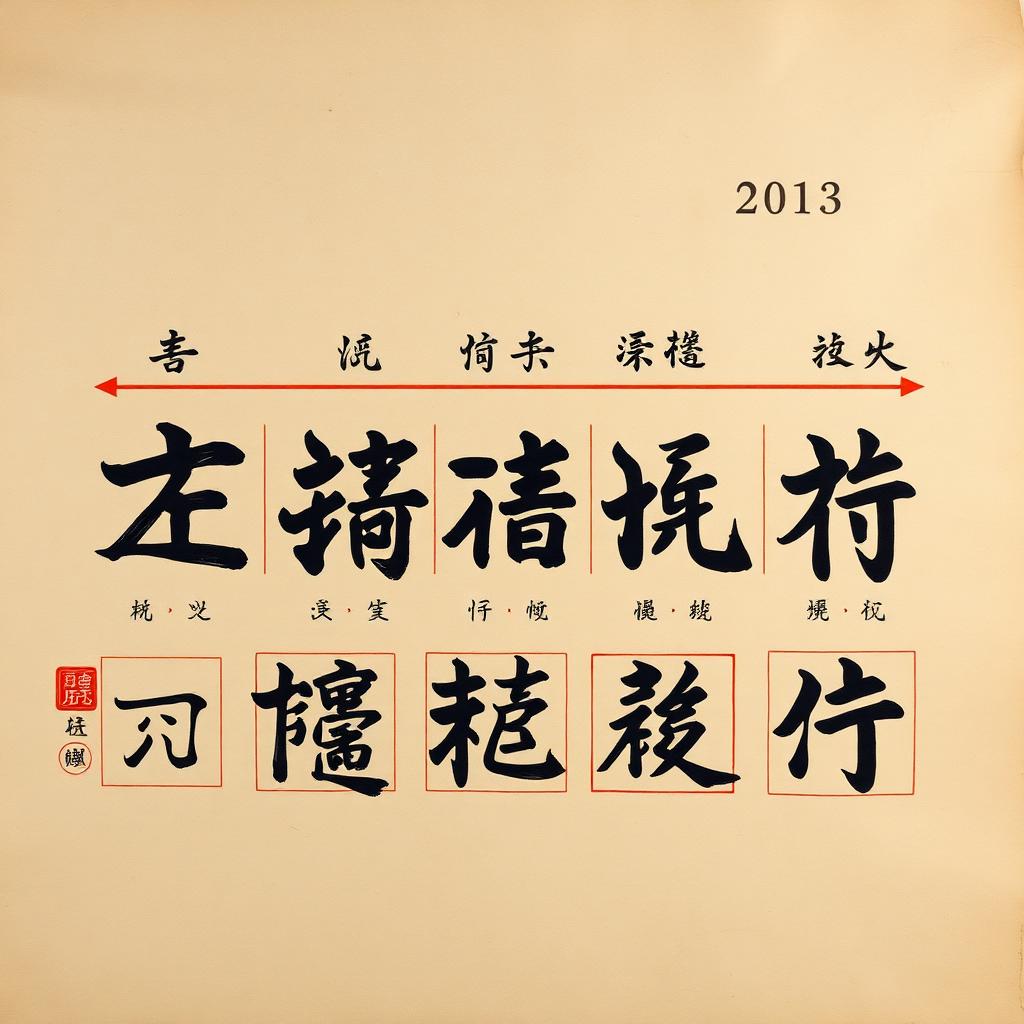
One of the recurring frustrations of learning classical Chinese is the sense that the script is a fixed, monolithic system that must simply be memorised. It is not. Every modern character sits at the end of a chain of transmission that runs, in the standard periodisation, through five stages: oracle bone (甲骨文), bronze (金文), seal (篆書), clerical (隸書) and regular (楷書). Following a single graph across the five stages is the single most efficient exercise a beginner can do, because it reveals the internal logic that flat memorisation obscures.
Take the character 車, "chariot," as the working example. In its Shang oracle bone form, 車 is a picture. A rectangular carriage box sits between two circular wheels; a long horizontal axle runs through them; a yoke curves up at one end. Depending on the scribe, the graph may be drawn with two, four or even six wheels, and the yoke may point left or right. The graph is diagrammatic rather than standardised: it describes a chariot, but it does not yet fix a normative shape for the word.
In Western Zhou bronze inscriptions the same graph is still recognisably a chariot, but the casting process has forced it toward geometric regularity. The wheels become perfect circles or squares; the axle is a single thick horizontal; the yoke is stylised into a hooked line. Crucially, the number of wheels stabilises at two. The graph is on its way from picture to sign.
The seal script of the Qin unification (221 BCE) completes that transition. In the Qin small seal (小篆) form standardised by Li Si, 車 is a tight vertical composition: a central rectangle for the carriage box, a horizontal line above and below for the axle, and two short verticals for the wheels. The graph no longer looks like a chariot to a casual viewer; it looks like a schematic diagram of one. This is the point at which the character has fully entered the writing system as a sign among signs.
The clerical script (隸書) that emerges in the late Warring States and dominates the Han is often described as the moment when Chinese writing "becomes modern." What actually happens is that the brush replaces the stylus and the reed pen as the dominant tool, and the graph is redrawn in strokes that a brush can execute in a single sweep. The circular wheels of seal 車 flatten into horizontals; the vertical strokes acquire the characteristic wave at the end (the 波磔 flare); the whole graph becomes wider than it is tall. If you can read modern Chinese, you can read most clerical 車 without help — the modern form is essentially a Han clerical form with the flares straightened out.
Regular script (楷書), codified between the Wei-Jin and the Tang, is the form we now teach to primary-school children and encode in Unicode. The chariot is unrecognisable: a rectangle, a horizontal, a vertical, two more horizontals. But every stroke can be traced back through clerical, seal and bronze to the original oracle bone picture of a two-wheeled vehicle drawn from above. The character is not arbitrary; it is a compressed history.
The pedagogical payoff of this exercise is not antiquarian. Once you have walked a graph through the five stages, you begin to see the same transformations everywhere. Circles flatten into horizontals. Enclosures square off. Redundant elements drop out. Semantic components (radicals) stabilise on the left or the top; phonetic components stabilise on the right or the bottom. The seemingly arbitrary shape of a modern character resolves into a small set of recurring historical operations.
It also disciplines the imagination. Popular etymologies — the ones that circulate on social media, in which every character is a poetic pictogram — usually collapse the moment you look at the seal or clerical stage. The graph you are being told means "a person under a roof cultivating rice" turns out, three stages earlier, to be a picture of something else entirely. The five-stage view is a corrective: it forces you to read the character as a historical artefact, not as an inkblot to project meaning onto.
A single sustained exercise — pick ten common characters, trace each through all five stages, and note what changes and what does not — will teach a beginner more about how the script actually works than a semester of vocabulary lists. The tools for doing it are all free. The rewards compound for the rest of your reading life.