Reading Small Seal Script: A First Pass at Xiaozhuan
The Qin small seal is the pivot on which the entire Chinese writing system turns. Learning to read it repays every hour spent, because it unlocks both the earlier and the later scripts.
Of all the historical stages of the Chinese script, the small seal (小篆, xiǎozhuàn) is the one modern readers most often encounter without knowing it. Any Chinese personal seal, any calligraphic frontispiece to a Republican-era book, any cinema title card for a period drama, will almost certainly be cut in seal script. It looks archaic, decorative and slightly opaque — which is precisely how the Qin unification wanted it to look when Li Si standardised the form in 221 BCE.
The historical fact is straightforward. When the Qin state finished absorbing the six warring states, one of its first acts of cultural policy was to impose a single writing standard on the empire. The chief minister Li Si, working from an existing Qin regional variant of the large seal (大篆), pruned redundant components, regularised stroke widths, and issued the resulting inventory as the imperial standard. The three lost primers he wrote to promulgate the new script — the Cang Jie Pian, the Yuan Li Pian and the Bo Xue Pian — survive today only in fragments quoted by Han authors. But the standard itself survives everywhere: on Qin weights and measures, on the First Emperor's mountain-top stele inscriptions, and, most usefully for the modern student, in the two-thousand-year-old Han lexicon Shuowen Jiezi, which uses small seal as its citation form for every headword.
That last point is why learning to read small seal is such an unusually good investment. The Shuowen Jiezi, compiled by Xu Shen around 100 CE, is still the foundational Chinese dictionary. Every serious modern lexicon — the Hanyu Dazidian, the Zhongwen Da Cidian, the Taiwanese Ministry of Education dictionary — cross-references the Shuowen entry. If you cannot read the seal form Xu Shen prints beside each headword, you are reading his dictionary at half strength.
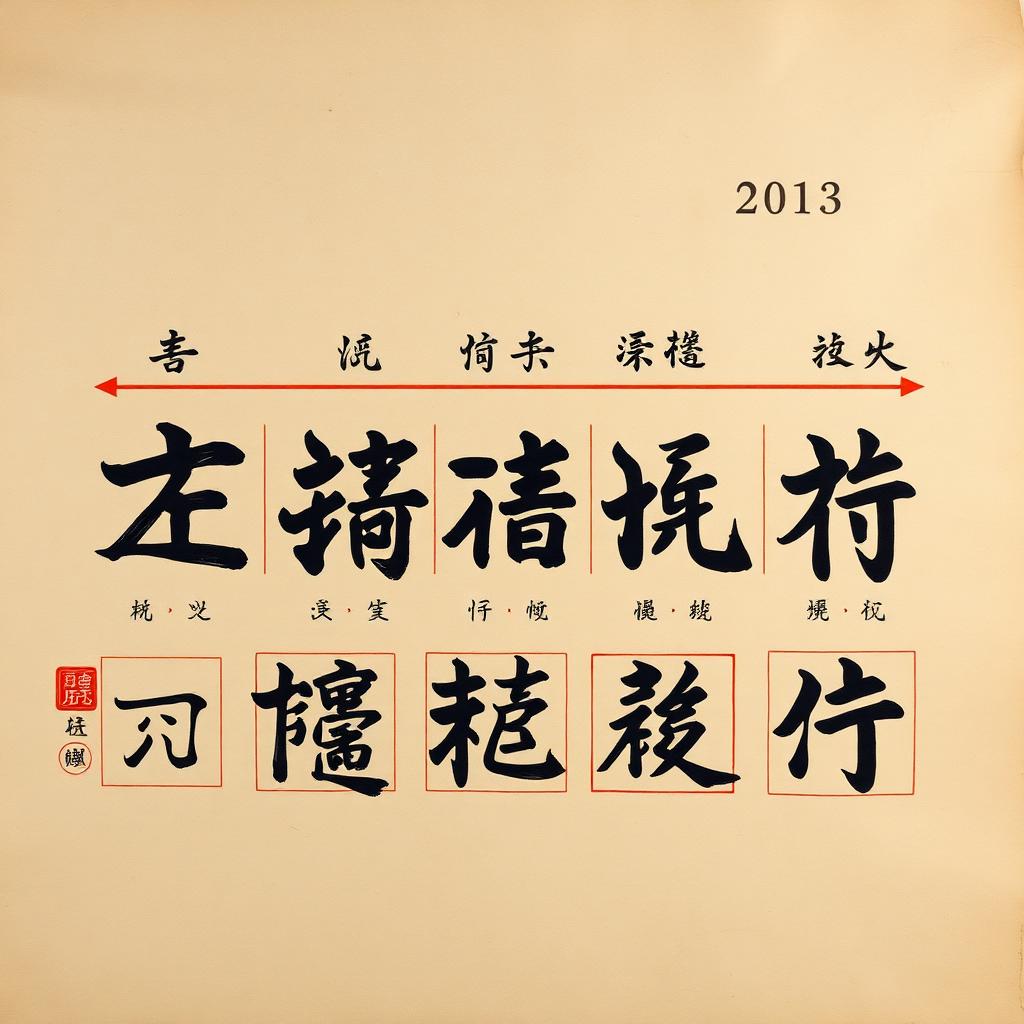
Where should a beginner start? The most efficient first exercise is to pick a hundred common characters and practise recognising their small seal forms alongside their regular script forms. This does not require calligraphy training; it requires only the ability to see the same graph in two disguises. Free open-source seal fonts (such as the Wenquanyi Seal set) will render any modern character in small seal at the click of a button, and the Chinese Text Project displays the Shuowen seal for any character you search.
There are a few structural principles that make the seal easier than it looks. First, seal graphs are strictly vertical: the width-to-height ratio is roughly 2:3, and horizontal strokes are exactly parallel. Second, curves are true arcs rather than the angular bends of clerical or regular script. Third, the internal geometry is symmetrical wherever possible; a graph with a mirror-symmetric semantic component will render that component with visible mathematical care. Fourth, and most importantly for reading, the seal preserves component divisions that clerical script has since fused. The seal form of 春 (spring), for instance, shows clearly the sun radical at the bottom and a distinct sprouting-plant component above; the modern regular form has collapsed the top into an opaque three-stroke bundle.
The Han and Tang tradition also gives us a useful shortcut. Xu Shen classified every headword into one of six categories (六書, liùshū): pictograph, ideograph, meaning compound, phono-semantic compound, borrowed and derivative. Roughly 82% of Shuowen headwords are phono-semantic compounds. In a phono-semantic seal form, the meaning component sits on the left or on top, and the phonetic component sits on the right or on the bottom. Once you internalise this bias, you can decode most unfamiliar seal graphs by asking two questions: what is the meaning component doing on the left, and what modern character shares the phonetic on the right? Half the time you will guess right on the first pass.
There are, of course, traps. A significant minority of seal graphs — perhaps 8% of the Shuowen — have been reanalysed by modern scholarship. The Xu Shen etymology may be wrong; the graph may be a fusion of two earlier characters; the component you identify as a phonetic may in fact be a semantic. This is where secondary sources such as Chiu Hsi-Kwei's Wenzixue Gaiyao and the Duan Yucai Shuowen commentary earn their place on the desk. Never treat a first-pass seal reading as final without checking one of them.
The other trap is calligraphic. From the late Ming onward, seal script was cultivated as an artistic form in its own right, and calligraphers such as Deng Shiru and Wu Changshuo produced deliberately elaborated variants that diverge from the Qin standard. When you encounter an inscription that looks like small seal but resists identification, the first question to ask is whether you are looking at Qin small seal, later imperial seal, or a Ming-Qing artistic re-imagining. The reference works differ accordingly.
None of this is an argument for reading only seal script. It is an argument for treating small seal as the middle stage in a five-stage journey — the pivot on which oracle bone and bronze look forward, and clerical and regular look back. Once you can hold a seal form and a regular form of the same graph in your head at the same time, the whole system stops being a memory palace and becomes a genealogy.