Punctuating a Classical Chinese Text: A Practical Method
Classical Chinese was written without punctuation. Restoring commas and stops to an unbroken text is a distinct scholarly skill — and the entry gate to reading pre-modern prose.
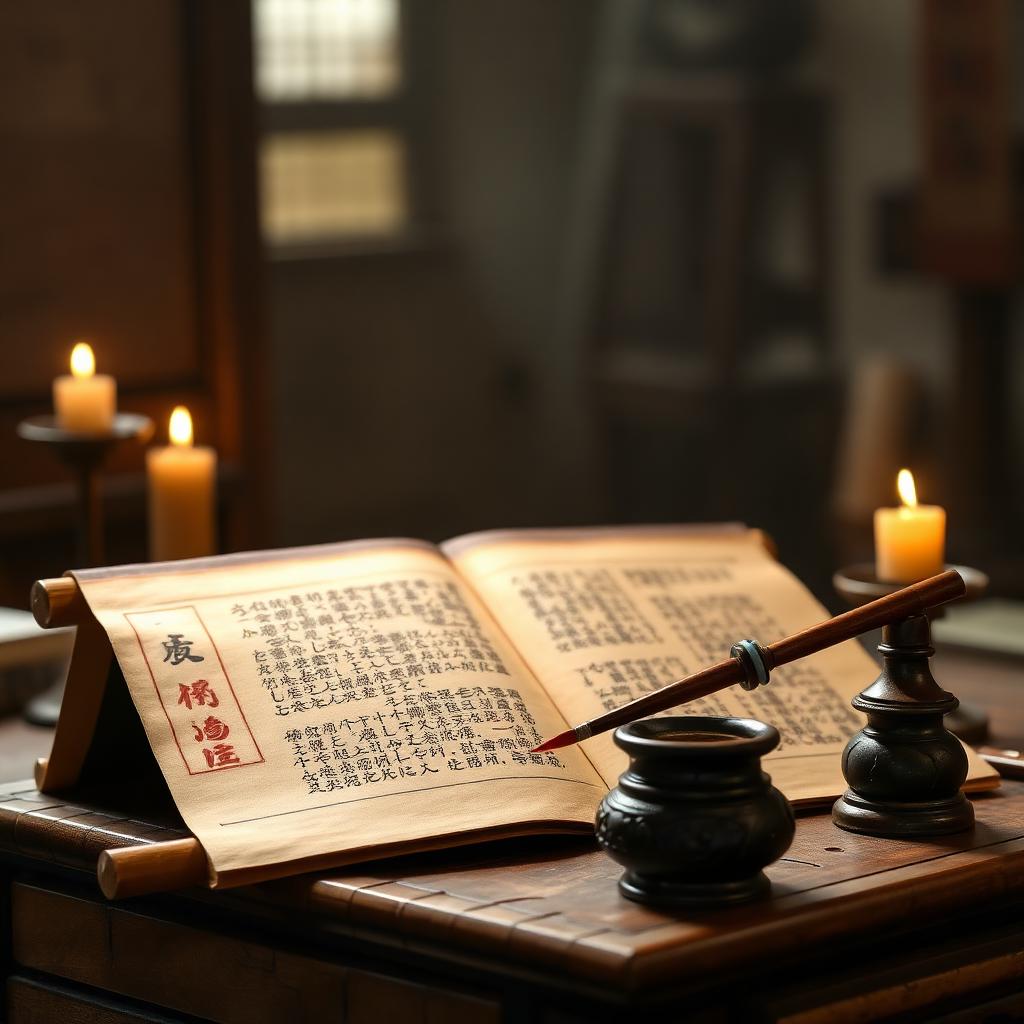
A working printed edition of a classical Chinese text — a Zhonghua Shuju edition of the Zuozhuan, say, or a Shanghai Guji edition of the Wenxin Diaolong — is a comfortable object. Commas, full stops, quotation marks and paragraph breaks divide the text into digestible units. It is easy to forget that none of that punctuation was there in any manuscript before the twentieth century, and that even the Song and Ming printed editions used at most a small circle or a triangular mark to indicate a major pause. Reading pre-modern Chinese, in its native state, means reading an unbroken column of characters and deciding for yourself where the clauses end.
This skill has a name: 句讀 (jùdòu, in modern Mandarin), the marking of "phrase and pause." It was the first thing a traditional teacher drilled into a student, and it remains the entry gate to reading classical prose. A student who cannot punctuate cannot read; a student who punctuates well is already halfway to translating.
The good news is that the method is teachable. Four heuristics, applied in order, will get a modern reader through the majority of classical prose.
First, look for the sentence-final particles. Classical Chinese marks the end of a statement with 也, a question with 乎 or 邪, an exclamation with 哉 or 矣, a hypothetical with 耳 or 爾. When one of these appears, you can be almost certain that a major stop belongs immediately after it. Beginners should mark every occurrence of these particles first, before doing anything else. The result is a rough scaffolding on which the finer punctuation can be hung.
Second, look for the sentence-initial connectors. 夫 at the head of a clause signals "now, as for…" and almost always follows a stop. 蓋 introduces a general assertion. 故 ("therefore") introduces a consequence. 是以 and 是故 do the same. Any of these particles, if it is not preceded by an obvious clause, tells you that the preceding character should be followed by a stop.
Third, look for parallelism. Classical Chinese prose, especially from the Han onward, is built on rhythmic four-character and six-character units. When you see two consecutive clauses of identical length and matching grammatical shape — 君子…, 小人… — the boundary between them is a comma, not a full stop. Parallel prose (駢文) is the extreme case, but even in the loosest historical narrative, parallelism is the single most reliable clue to clause length.
Fourth, consult the sense. Once particles and parallelism have divided the text into candidate clauses, the final check is semantic: does each clause say something coherent? If a proposed clause leaves a verb without a subject, or a subject without a verb, the boundary is probably in the wrong place. Move it one character forward or back until the clause reads.
There are traps. Names of people, places and offices frequently contain characters that look like particles. The 也 in a personal name is not a sentence-final particle; the 之 in a place name is not a genitive marker. A short reference to the standard biographical and geographical dictionaries — or a quick pass through a modern punctuated edition of the same author, if one exists — will catch most of these.
Direct speech is another trap. Classical Chinese introduces speech with 曰 ("said") but does not close it. The end of a quotation must be inferred from context: usually it ends when the narrator resumes with a new subject, or when a sentence-final particle is followed by a new clause that clearly comments on what was just said. Modern editions punctuate quotations with the standard hooked marks 「」 or 『』, but the underlying decision is always interpretive.
The best way to build the skill is to work with a text you already half-know. Take a familiar passage of the Analects or the Daodejing, print it without punctuation, and re-punctuate it from scratch. Then compare your version to a standard edition. The disagreements are almost always instructive: they reveal a scribal ambiguity that the editor resolved in one direction and you resolved in another. Neither of you is necessarily wrong. That is the honest condition of the classical text.
Automated punctuation tools have improved dramatically in the last five years, and any serious reader will use them. But the tools are only as good as the training corpus, and they systematically err on rare authors and technical genres. A working knowledge of the four heuristics above is what lets you use an automated pass as a first draft rather than a final answer.